
















When Egyptian feminist group Speak Up announced a partnership with Pornhub—the world’s largest website for adult content—to rapidly identify and remove non-consensual content, it received immediate backlash. Are its efforts meeting the reality of sextortion in the country, or normalizing a platform that has often hosted non-consensual and illegal content?

The global attention of the #MeToo movement prompted the aid sector to acknowledge its own #AidToo crisis, but, half a decade later, the spotlight has dimmed, and sadly, the aid sector has seen minimal substantive changes.

After nearly two years since the Russian invasion of Ukraine, the unchecked exploitation of Ukrainian women abroad — who are still displaced in different European countries, as well as internally, in Ukraine — is poised to create a crisis of sexual abuse and sex trafficking.

Myanmar's garment worker union members are not only fighting for an end to military dictatorship; they are also fighting for the elimination of systemic harassment and violence that has plagued their lives long before the coup.
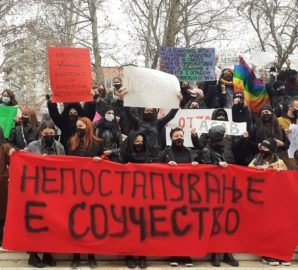
When a Telegram group called “Public Room” was discovered sharing private images and contact information of countless women and girls from across North Macedonia without their consent, the outrage was swift, but authorities' lackluster response to online crimes against women signals a critical need for more protections — and better enforcement.
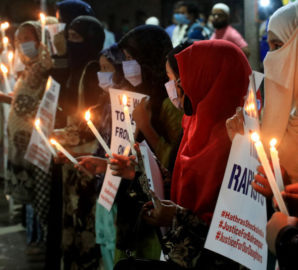
A cocktail of structural barriers with law enforcement and throughout the judicial process — such as drawn-out, humiliating investigations and trials — ensures that justice for victims remains evasive.
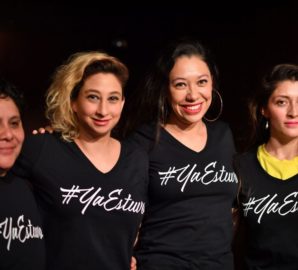
As the #MeToo movement steadily grows throughout Mexico, with thousands of actions, collectives, and ongoing projects in operation throughout the country, women are finding their power to fight back and build a society in which their lives are not in constant danger.

Sexual harassment and bullying of women have long been commonplace in Nigeria’s bustling markets. Now, women are leading the charge to change its culture.

When toxic masculinity is present at an anti-harassment training.

When in August Brazilian writer and feminist activist Clara Averbuck refused the advances of an Uber driver, he physically threw her out of his car, leaving her bruised and with a black eye. He then sexually assaulted her as she lay on the ground.


Let’s blame men. Many of us do—many women and even men blame men for the mass rape of women in war. It’s easy to point our fingers and name the perpetrator. But what if we were to step back and ask how men can actually be part of the solution? It requires a couple of basic assumptions.