














The Women’s Media Center’s research and reports shed a light on the underrepresentation and misrepresentation of women in the media.


The Primetime Emmy Awards have opened more doors for people to get nominated, but it doesn’t mean that more women are being invited inside. The number of women nominated for non-acting Primetime Emmys in 2021 decreased by three percentage points compared to 2020, according to the most recent Women’s Media Center (WMC) analysis.

Television is an industry where “gender parity” in non-acting jobs is often discussed but rarely achieved. And when it comes to the Primetime Emmy Awards, the total numbers of women who get nominations in non-acting categories have continued to stall at below 40% every year. For the 2022 Primetime Emmy Awards, 33% of the non-acting nominees are women. This is barely an increase from last year, when women were 32% of the non-acting nominees for the 2021 Primetime Emmy Awards.

Female representation dropped overall this year in the nominations in 18 non-acting categories for the 94th Academy Awards. Of the 205 people receiving nominations this year, 55 (27%) are women, compared to 150 (73%) men. This is the lowest rate of female behind-the-scenes representation at the Oscars in three years.

Female representation dropped overall this year in the nominations in 18 non-acting categories for the 94th Academy Awards. Of the 205 people receiving nominations this year, 55 (27%) are women, compared to 150 (73%) men. This is the lowest rate of female behind-the-scenes representation at the Oscars in three years.
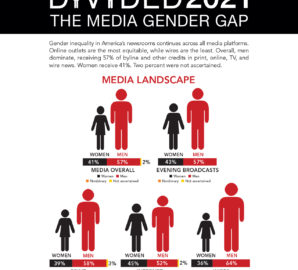
Gender inequality in America’s newsrooms continues across all media platforms as men overall receive 57% of news bylines and credits and women 41%, according to the Women’s Media Center’s latest report, “Divided 2021: The Media Gender Gap.” Two percent were not ascertained.

The Status of Women in the U.S. Media 2021 is comprised of 109 studies and reports, including original research by the Women’s Media Center and aggregated research from academia, industry and professional groups, labor unions, media watchdogs, newsrooms, and other sources.

This “WMC Report: Gender and Race Representation on Five Big Sunday Shows” tells a story about guests on influential, agenda-setting television programs. The study finds that women and people of color are practically invisible — two-thirds of the guest appearances are by men and nearly three-quarters are White. White men comprise the overall majority of all guest appearances on these programs.

This “WMC Report: Gender and Race Representation on Five Big Sunday Shows” tells a story about guests on influential, agenda-setting television programs. The study finds that women and people of color are practically invisible — two-thirds of the guest appearances are by men and nearly three-quarters are White. White men comprise the overall majority of all guest appearances on these programs. Here are the infographics:

Despite women making history in the top categories at the Oscars, the number of female nominees for the 93rd Academy Awards did not see a significant increase compared to past years, according to a Women’s Media Center analysis of the 18 non-acting categories.

The Women’s Media Center research found that a bigger pool of nominations for the 72nd Primetime Emmy Awards hasn’t made much of a difference in bringing overall gender parity to the nominations in behind-the-scenes categories: Women represented 35% of those nominations while men were 65%.

The Women’s Media Center report - WMC 2020 Investigation: Gender & Non-Acting Primetime Emmy Nominations - shows that a bigger pool of nominations for the 72nd Primetime Emmy Awards hasn’t made much of a difference in bringing overall gender parity to the nominations in behind-the-scenes categories: Women represented 35% of those nominations while men were 65%.

This report looks at online harassment and its connection to internal corporate culture, shedding light on the relationship between online harassment and systemic bias in the newsroom.

The number of nominations for women increased in the 92nd Academy Awards, but not by much, according to a Women’s Media Center analysis of the 19 non-acting categories. The overall percentage of female nominees in those categories rose by just 5 percentage points, from 25 percent last year to 30 percent this year.
Ten things I’ve learned in my years of extensive reporting on sexualized violence that may help you navigate this most sensitive kind of reporting.

Despite a year in television that was dominated by female-driven content on screen, gender parity remains elusive for women in non-acting nominations for the 2019 Primetime Emmy Awards, according to the most recent Women’s Media Center analysis.

SuperPowering Women in Science Fiction and Superhero Film — A Women’s Media Center Report in Association with BBC America, our second joint study, explores the overall history of female representation in front of and behind the camera in the science fiction and superhero film genres and conducts a deeper dive into representation in the past decade.

“The Status of Women in the U.S. Media 2019” shows that despite some gains, men still dominate in every part of news, entertainment and digital media. The report is comprised of 94 studies, including original research by the Women’s Media Center and aggregated research from academia, industry and professional groups, labor unions, media watchdogs, newsrooms and other sources.

The 2019 Oscar nominations were disappointing for women behind the camera, with no women nominated in Directing, Cinematography, Editing, Original Score, and Visual Effects, and only one woman nominated in Animated Feature film and in each of the two writing categories. Industry-wide efforts to improve gender parity has had some impact, but not as much as anticipated, according to a Women’s Media Center analysis.

According to a recent report by the Women’s Media Centre, of coverage by 28 American news outlets in late 2017, men received 63% of bylines and TV credits—one percentage point higher than their share the previous year.

Journalism remains dominated by male reporters and their male sources. A studypublished recently by the Women’s Media Center found that in 2017, 63 percent of bylines and TV credits were those of men.

SuperPowering Girls: Female Representation in the Sci/Fi Superhero Genre is the first in a series of reports that BBC America and the Women’s Media Center will release over the next few months with a goal of expanding both the diversity and representation of women and girls in front of and behind the camera.


A year following revelations in The New York Times about decades of allegations against movie producer Harvey Weinstein, the #MeToo movement has led to a significant change in the way media covers stories about sexual assault and harassment, a new report from the Women’s Media Center shows.


This ever-growing list of analyses explains how sexualized violence is used as a weapon of war.


This is meant as an informal guide for journalists who cover sexualized violence or want to, mainly in an international context.


