















How personal abortion stories are countering the anti-choice movements lies
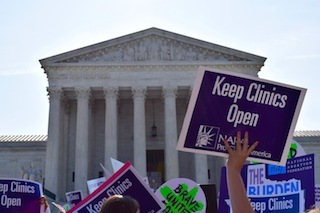
Over the past five months, states including Louisiana, Missouri, and Georgia have passed heartbeat bills, which ban abortion at six weeks, when many women don't even know they're pregnant. By referencing a heartbeat, these bills intentionally evoke an image of protecting a "live" fetus from abortion. But as OB-GYN Jen Gunter writes, and other experts have confirmed, the "heartbeat" these bills reference isn't a heartbeat at all, but "a thickening at the end of a yolk sac" called a fetal pole.
The use of the term "heartbeat" — and the idea of a fetus's humanity — is just the latest way anti-choice politicians are imposing their belief that life begins at conception and that abortion is murder onto Americans. This strategy has been and is still being used beyond the heartbeat bills, too.
Take, for example, Donald 'Trump's mischaracterization of New York and Virginia's pro-choice laws earlier this year. These laws would expand a woman's right to terminate a pregnancy when it endangers her life. Trump, however, characterized them as essentially allowing a mother to rip a baby from her womb moments before giving birth. This graphic language intentionally paints ending a pregnancy as an act so cruel that there could be no ethical reason to do so. Though the mother is only mentioned in passing, the implication is that she is a heartless person, willing to put an unborn child through unimaginable suffering. In this paradigm, seeing the fetus as a human requires that the mother lose her humanity; it reduces her to the embodiment of cruelty.
The most critical voices among those pushing back against this recent onslaught of anti-choice legislation and rhetoric are those of people who have been pregnant or had abortions themselves. In March, Georgia State Senator Jen Jordan revealed in a speech responding to her state's heartbeat bill that she'd suffered eight miscarriages. This experience, she said, taught her that a woman's choice to terminate a pregnancy is one of the most intimate and personal decisions a person can make.
Washington House Rep Pramila Jayapal also shared her experience of having an abortion with the New York Times in a June 13 op-ed. After enduring a difficult first pregnancy, Jayapal decided to terminate her second pregnancy, which was also high-risk. "I knew that I simply would not be able to go through what I had gone through again," she wrote.
Actress Busy Philipps has also been outspoken about reproductive rights. In May, she started the hashtag #YouKnowMe on Twitter to show how common the choice to terminate a pregnancy is by encouraging others to share their stories. Later that month while speaking at the summit "In Goop Health," Philips opened up about having an abortion at 15, saying, "I don't have [any] shame. I'm glad I didn't have that guy's baby."
While the context behind and circumstances of these personal stories may differ, their power lies in their ability to shift perspectives of those who hear them. These stories show how women choose to have abortions not out of malice but to make the best choices for themselves and their unborn children. Humanizing this choice — and, specifically, the women making that choice, whom conservatives seek to erase from their narratives about abortion — not only makes the decision more understandable to those who may theoretically oppose it, but also proves how misguided it is to depict people who seek or who have had abortions as villainous.
These personal stories also reveal just how antithetical opposing abortion can be to conservatives' supposed goal of supporting the wellbeing of an unborn child. After Georgia passed its "heartbeat" bill, VICE News interviewed several Georgia couples who had late-term abortions and asked them about their thoughts on the law considering their experiences. Each of the subjects revealed that they wanted their pregnancy but terminated it for the health of the child. The interviewees emphasized that they made this decision as mothers looking out for the best interests of their children. One mother, Erika said, "If I can make a choice where it's the best outcome for my child to not have to suffer then that's what I'm going to choose." Erika's remarks show the irony that at times, ending a pregnancy is actually what's best for the baby and to deny families that choice prolongs suffering.
Personal stories also do much to combat the straight fallacies Trump (and other conservatives) spread about abortion. VICE News asked the Georgia couples to respond to Trump's repeated claim that some abortions essentially amount to women executing their babies at an April rally in Wisconsin. As one woman named Malika explained, "Sometimes politicians paint this picture of these evil women that are out there wanting to kill babies." Gesturing to herself and her partner, she continued, "This is what's real. We're a family that wanted to have our daughter, tried to have our daughter...People need to start thinking about the real and not just the story about abortion."
More articles by Category: Health, Politics
More articles by Tag: Abortion, Law, Activism and advocacy, Reproductive rights


